HSBC zero forex offer until 30th September 2026
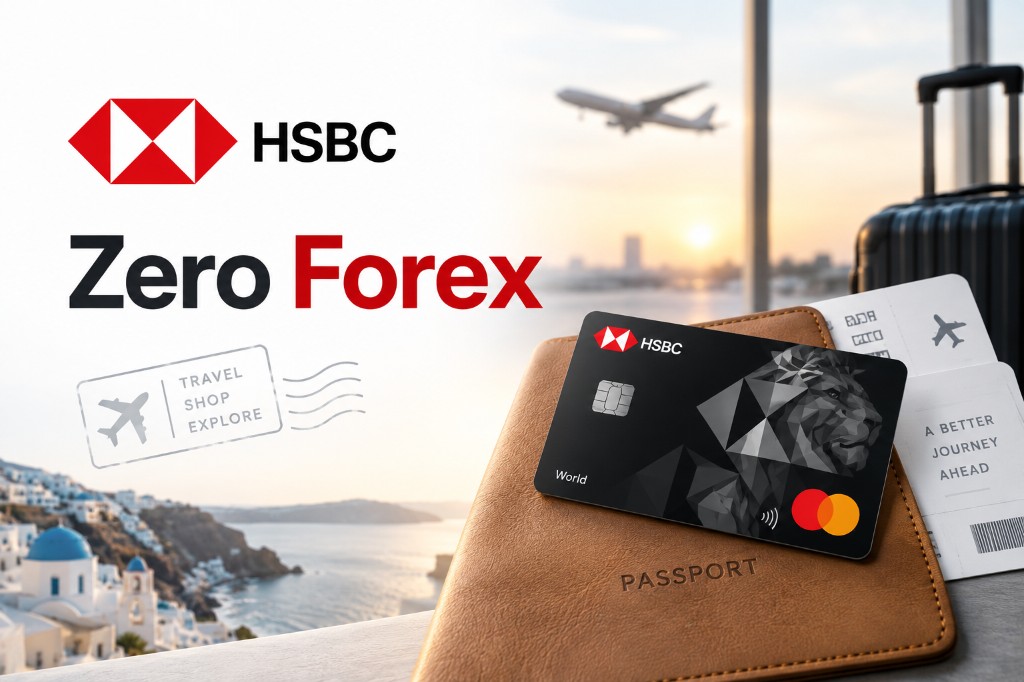

HSBC has rolled out a zero forex markup offer on its personal credit cards, and it runs till 30 September 2026. Since it began on 15 August 2026, overseas hotel bills, foreign website purchases, and subscriptions billed in dollars or euros can avoid the usual forex markup for now.
The offer runs from 15 August 2026 to 30 September 2026. HSBC goes by the posting date on your statement, not the day you swiped. Buy something on 30 September and it can easily post in October, and then you pay the markup.
Who gets it
- Personal HSBC credit cards, for Indian residents and NRIs.
- Spends on your add-on cards count too.
- Corporate cards are left out.
- A card you have closed or cancelled will not qualify.
What counts as a forex spend
Any spend in a currency other than the rupee, whether you swipe it at a shop abroad or pay online from home. Cash you take out of an ATM is left out. So is a transaction you have raised a dispute on.
Your points and cashback work like always. The offer takes off the markup fee and leaves the rewards side of your card alone.
What you will still pay
HSBC is waiving its own markup and nothing else. GST, the card network's cross-border fee, and the rate at which your spend gets converted into rupees are all still there. Zero markup does not make a foreign spend cost the same as one at home.
One more line in the T&Cs worth knowing: this waiver cannot be clubbed with any other HSBC forex offer or benefit. So if your card already runs some other overseas promo, you get one or the other, not both.
When a card machine or a checkout page asks if you would like to be billed in rupees, pick the local currency instead. That rupee conversion is done by the merchant's side and the rate is usually worse than what your own card would have given you. More on this: How to avoid DCC abroad and What is DCC?.
How much this is actually worth to you
Depends entirely on which HSBC card is in your wallet. Some of them already charged very little on forex, so the waiver barely moves the needle. Others charged the full 3.5%, and for those this is a real saving. These are the published rates outside the offer:
| HSBC card | Usual forex markup |
|---|---|
| TravelOne | 3.5% |
| Visa Platinum | 3.5% |
| RuPay Platinum | 3.5% |
| Smart Value | 3.5% |
| Live+ (Cashback) | 1.99% |
| Premier Metal | 0.99% |
| Taj, Privé | Already nil |
On ₹1 lakh of foreign spend, 3.5% is about ₹3,500 before GST. At 0.99% it is under ₹1,000. If you hold Taj or Privé, you were paying nothing anyway and this offer changes nothing for you. Rates do get revised, so check your own MITC rather than taking this table as gospel — the RuPay Cashback card, for one, had a 0% markup that was only published till 31 July 2026.
HSBC TravelOne normally charges 3.5% on forex but pays 4 reward points for every ₹100 on international spends. With the markup gone till 30 September, you are earning the full 4 points per ₹100 overseas and paying no HSBC fee on it. What those points are worth depends on where you send them — more on that below.
If you want 0% forex without a deadline hanging over it, read our IDFC FIRST zero-forex update. And for a lower-fee HSBC card year round, HSBC Live+ sits at 1.99%.
What I put through this window
TravelOne is the card I use, so this one landed at a good time for me. 4 reward points per ₹100 on international spends, and right now no markup sitting on top of it. Everything dollar-billed that I had been putting off went on the card in these few weeks:
- A Google Play Console developer account. One-time fee, billed in dollars, and no forex charge on it.
- Cursor for a year. I moved off the monthly plan and paid the annual one instead.
- A design tool, also a one-year plan rather than month to month.
None of this was new spending. I needed the Play Console account, and the other two I use every day and was going to keep paying for regardless. What the offer changed was the timing — a year upfront inside the window, instead of a monthly charge quietly picking up markup twelve more times.
Where my points actually go
I move HSBC reward points to Accor ALL, and that transfer runs 1:1 — one reward point becomes one ALL Reward point. Accor prices its points at 1,000 = €20, so each one is worth about ₹2.2 to me at current rates. That is the number I judge this card on, not the voucher rate.
Which changes the maths a fair bit. Every ₹100 of international spend earns 4 points, and at ₹2.2 each that is about ₹8.8 back — call it 8.8% in Accor value. Add the markup I am not paying this month and a ₹50,000 run of renewals looks like this:
| On ₹50,000 of foreign-billed renewals | Value |
|---|---|
| 4 RP per ₹100 → 2,000 reward points | — |
| Transferred to Accor ALL at 1:1 | 2,000 ALL points |
| At 1,000 points = €20 (about ₹2.2 a point) | ≈ ₹4,400 |
| Forex markup not charged (3.5%) | ≈ ₹1,750 |
| Total | ≈ ₹6,150 |
That only holds if you actually stay at Accor properties. Fixed-value points are still only worth something when there is a booking you want, and ALL burns in blocks of 1,000, so odd balances sit idle. The rupee figure also drifts with the euro. If you would rather cash points out as vouchers, value them closer to ₹1 and the return drops to the ~4% HSBC markets. Check the live ratio in the HSBC portal before you transfer — see how to book an Accor stay with points for what the redemption looks like end to end.
If something foreign-billed is up for renewal soon, or you are on a monthly plan for a tool you know you will keep, switching to the annual plan before 30 September gets the whole year's markup waived and the points in one shot. Only worth it for things you were going to renew anyway. Prepaying a year on a tool you might drop in March, just to dodge 3.5%, is not a saving.
Before you spend
- Check that international transactions are switched on for your card, in the app or on net banking.
- Get the big overseas spends done a few days before 30 September so they have time to post.
- Pay in the local currency every single time. Never accept the rupee prompt.
- Look at your statement after the first foreign spend. The forex markup line should be gone or sitting at 0%.
- Keep a copy of the T&C PDF in case you have to go back to HSBC about a charge.
- HSBC India: Zero forex markup offer T&Cs (PDF)
- HSBC Live+ review on Travel on Points
- IDFC FIRST zero forex + rewards update
So, is it worth using?
If you already have foreign spends lined up in the next couple of weeks, put them on your HSBC personal card. You save the markup and still earn your usual rewards. Just keep in mind that corporate cards and ATM cash are out, and do not leave it to 30 September, because a spend that posts in October will not get the waiver.